
Adding Up to Insanity

Most people have problems comprehending big numbers. I’m not talking about accurately comprehending the number of drinks you’ve had, the kilograms you are currently overweight, or even the size of your personal domain of fame. No, I am talking about issues with comprehending really big numbers.

Remember that ploy Carl Sagan used in his Cosmos program to demonstrate the size of the galaxy within which we reside? He grasped a handfull of sand on a beach asking if we might appreciate how many grains of sand there might be in his fist. That’s a big number. Then he went on to suggest that the number of stars in our galaxy is larger than ALL of the sand in ALL of the world’s beaches. Sobering stuff for those who insist on the substantive peculiarities of their own personal existence…

How many people can really imagine the world’s entire human population? 6 going on 7 billion! How many people can really comprehend a number like that? Particularly when, for most of us, the world’s population is generally calculated more like this: (me+family+workmates+people I know personally) = (a really big number) ≤ (the number of folk in my local city) which, in turn, is approximately = reality as I understand it. All the rest [(world’s population) – (local community)] is just an abstract number. Just like all those grains of sand in all the world’s other beaches.
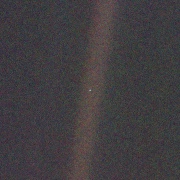
Carl Sagan always held to the proposition that we poor self-centred humans would never understand the relative place of our race, if not our planet, until we could see it as a tiny blue dot from outer space. Which is precisely why he convinced NASA to turn Voyager 1’s camera eye back on earth 3.7 billion miles from home to make his point:

Look again at that dot. That’s here. That’s home. That’s us. On it everyone you love, everyone you know, everyone you ever heard of, every human being who ever was, lived out their lives. The aggregate of our joy and suffering, thousands of confident religions, ideologies, and economic doctrines, every hunter and forager, every hero and coward, every creator and destroyer of civilization, every king and peasant, every young couple in love, every mother and father, hopeful child, inventor and explorer, every teacher of morals, every corrupt politician, every “superstar,” every “supreme leader,” every saint and sinner in the history of our species lived there – on a mote of dust suspended in a sunbeam. Carl Sagan, Pale Blue Dot, 1994

The importance of our local community, if not our own self-importance, if not the importance of everyone else we could ever know, was rather emphatically demonstrated at that point. Big numbers and big dimensions are humbling… or should be for such a self-obsessed species as ourselves.

All of which, I think, explains the current head-in-the-sand absurdities of contemporary arguments and denialism over the contributions of humans to global warming. This argument, so everpresent in the more conservative circles of modern society (the professorial tea parties of contemporary academia, for starters…), and amongst all the rest of us who lack an education and/or an intellect. No, most folk can’t comprehend the accumulative destruction we collectively dump on this poor pale blue dot of a planet to which we are currently confined.

The logic works like this: my own personal emissions are small. Because I can’t comprehend numbers bigger than (say) 12, the collective contributions of society as comprehensible to me (my local town, say) must also be small. Therefore, human-induced global warming must be bunk. Or at least it must be bunk in my back yard (which is, let’s face it, pretty much the whole world that’s comprehensible to most of us – everywhere else is just the stuff of marketing fancies in travel brochures…).

Here’s an extract from my motorcycle owner’s handbook (the only oil-fired vehicle I own – the other six are bicycles…):

Exhaust fumes are poisonous and can cause loss of consciousness and death within a short period of time. Always operate your motorcycle in the open-air or in an area with adequate ventilation. Triumph Tiger Owners Manual, p. 56

Consider this warning… The fumes just this one bike emits are enough to kill me. Where do those fumes go to? Do they leak into outer space and gas aliens in the Betelgeuse system? No. They are glad-bagged into the atmosphere clinging precariously to our planet. Now imagine how much a car with 2 – 3 times the engine size of my bike might emit. Now multiply that by, wait for it, 700 million (cars in the world today)! That’s an incomprehensibly huge emission of toxic fumes! Every minute of every day, day in day out, year after toxic year. Most cars are currently emitting something like 350 to 500 grams of carbon dioxide per kilometre travelled. How could this kind of thing NOT harm us or our planet? That’s a big clean-up burden for those trees we have condescended to leave in the ground (an acre of forest is needed to clean up the emissions of each of those 700 million plus (and growing) cars per year, more or less…).

Putting aside the science of atmospheric dynamics et.al., I’d simply propose this simple experiment through which we can re-connect with the consequences of our comprehensibly local actions. If you live in a city, go visit a national park (well away from civilisation) for at least a week. Clear your lungs. Return to the city. Breathe in. What do you notice?! If you live in a rural place, go visit the city and breathe in the air. If that’s not enough to prove the point, take up urban cycling. Ride in traffic. You will see what I mean pretty quick smart. Your eyes will water, your lungs will scream. You will die a bit more for every second you spend in the fume tanks of our urban places. Is this not a graphic pale-blue-dot moment through which we might connect to the realities of what it is that we each do to this planet of ours? How can any person put his or her head in the sand of non-contributive innocence when he or she drives a car?

But still we deny personal responsibility! And keep on keeping on doing it despite all the oceans of government clean-up-our-act rhetorical spin. People stick to their delusion that it’s not what I do but what everyone else does that is the problem. Why and how does the individual become so separated from the notion of personal contributions to collective consequences on the occasion of driving a car?

I know how to fix the problem. Instantly. It’s a perfect cure. It’s a perfect way to connect the consequences of individual actions back to their perpetrators. Connect a pipe to the end of your exhaust pipe. Channel that pipe back in through the window of your cabin. Keep the windows up and inhale. Then cyclists will, truly, finally, inherit the earth… As Darwin’s logic would inevitably postulate.
Pilgrimage to the End of Days

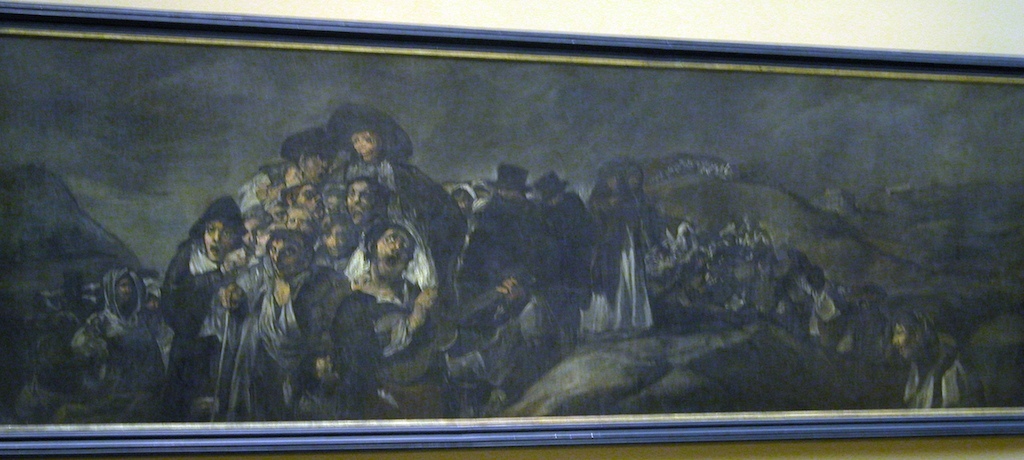
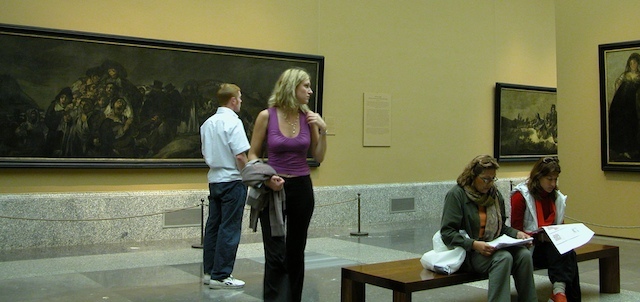
What does this painting do for you (click on it for a larger view)? It’s the Pilgriage of St Isidore by my favourite painter, Francisco Goya. It is one of Goya’s ‘black paintings’; painted on the wall of his country house west of Madrid in 1821. Painstakingly peeled off that wall, this work was eventually transferred to canvas and placed in the Prado Museum in Madrid where today, you too can sit under it and contemplate the mental imagery it so furiously invokes.

There are Goya paintings all through the Prado. But none, in my view, match this. It’s wall fillingly huge. It’s breathtakingly mesmerising. It tells stories.

The story this work speaks to me is the march of our race to self-imposed destruction. A self-imposed, self-deserved march to hell… It is a black painting, after all! Do you expect that a work coloured by all the shades of hell could invoke anything else?

There are a few components of this picture that add up to the picture of misery the image portrays to me. The long chain of followers, following one-by-one in the almost dark depths of a gloom blanketed blasted landscape is the central story element. The faces of those you can see at the front of this queue tell all without the need for words. It’s not a happy picture! Nor should it be.

The mental movie this picture invokes is of a directionless, pointless march from the place we once might have called home to the homelessness of a world gone universally bad via the accumulative destruction each and every one of us has inflicted on an environment we all knew was at its limit. This is the panorama of the end-of-days to follow our hedonistic orgy of oil-burning, greenhouse emitting overindulgence in planetary exploitation. An orgy of the abject pursuit of consumerism unconstrained by even the concept of self-responsibility. This tragic parade of misery is a column of recognition that the things we each do add up, add together and come down on us like a torrent of universal pain. The folk in this plodding directionless pilgrimage to nowhere probably all, now, realise what it is that they have done. Now, at last, they are connected in their sharing of the circumstances to which they have each contributed. I see harmony in this crowd. They all share the misery that’s now their collective reward. No one is more to blame; their fate is shared.

One wonders what this crowd might then do if it could be directed backwards in time to adjust the contributions each and every one of them have deposited to their unpleasant collective fate. How would they have done things differently to preclude the inevitability of this march to hell?

Is this an inevitable fate? Is this meandering pointless parade our ultimate journey? What’s Goya trying to say? What’s this painting telling you? I believe there is a clue embedded here. Notice that this crowd is both amorphous in endless anonymity while, at the same time, is personalised via an uncensored expressive focus on the faces of those in front. This tells us that this meandering line of misery is a line of individuals, each contributing to the whole we see spread so widely across this wall. The whole is a sum of its parts. The whole is a place we don’t want to be. You can see that in the face of the few faces highlighted at the front; despite the brave display at least one of them is trying to invoke (that tragic guitarist singing a tune I suspect is as black as the scene). We can imagine that every face in the line might be of equally agonised demeanour. This reinforces the reality that the totality of any crowd is simply the accumulation of individuals. It’s what each individual does, one influencing the other via socially constructed cultures of interaction, that accumulates to the panoramic wide-screen of misery that this painting so breathtakingly presents. These pilgrims each share membership of a whole gone very wrong.

They could, conceivably, also be members of a collective with an entirely different fate. If each and every person in this conga line of shared depression could have a second chance, do you think their ultimate fate would be the same?

It’s a sobering blockbuster of a painting, this. It’s a powerful siren through which to wake us from our individual contributions to an intolerable collective destruction. This crowd needs reconfiguration. The story needs to be re-blended from scratch. If you ever get to the Prado, make sure you spend some time to hear the story it might invoke in you. I found it hard to drag myself away. I can’t recall any work of art that has produced such an impact as this. It’s worth the trip to Madrid…


A Disease Worse than Plague

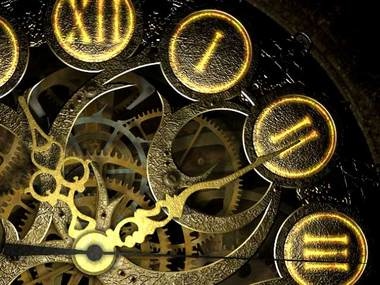
It is hard not to admire a cleanly efficient machine. The intricate efficiency of the traditional mechanical clock, the wonderous perfection of the bicycle, the impressive busyness of a bottling plant; you name it. We especially like machines that embed a kind of art through the connection of form and function (with the road racing bicycle or the new see-through Rolex as the greatest human achievement in this regard).

People surrounded by the infinite and usually confounding complexities of our lives tend to take refuge through their admiration of machines. Here at least is one place that can stay steadfastly on track with only the occasional touch of oil or a replacement part. While the rest of the world wallows in confusion, our machines can continue on undaunted. Those connected into the true depths of confusing complex reality, like the managers of large organisations, often tend to develop solid devotions to machines where all the working parts perform on a stage of solace from the incapacity of the human world to follow suit. They might collect antique clocks as refuge after a hard day of herding cats at the office.

As organisational confusions increase through ever more elaborate corporate and government policy rules, the relentless pace of globalisation, and the dynamic infatuations of human kind to indulge in things like religious fundamentalisms, wars and various forms of tribal jingoism, it is rather predictable that some if not many managers start to imagineer the conversion of their own part of the world into something a bit more like the clocks they collect.

Wouldn’t it be nice, the deluded might think, if the university, bank, hospital, government department or pencil factory could be constrained to operate just like a clock. A clock with all the mechanicals exposed so that we can observe the workings with a satisfied sense of seeing all the bits and the whole working in undaunted harmony. The temptation must be great.

The trouble is that, like the thirst of an alcoholic, the desire for this kind of mechanical conversion of unrelentingly unruly complexity has become a disease. Managers in every space are doing far more than simply wishing for the mechanical conversion of their workplaces; they are busy forging those delusions into reality. This trend has a name. That name is ‘managerialism’. Managerialism is the attempt of a manager to squeeze out the idiosyncrasies, confusions and, really, humanness of the systems that are to be the victim of this disease. Managerialism is the delusion of managers who tremble with insecurity in the face of inescapable real world complexity that they can indeed manage the systems over which they are empowered, just like the simple machinery they wish the world could become.

It never works. Because complexity has depths that are hidden to any and all attempts at detailed exploration. And stuff from the depths can surface at any time to shake an organisation in ways that are utterly unpredictable. Any possible theory a manager might have on how the system they are managing works is flawed or incomplete at best. This applies to economists who fantasise omniscience about how economies work (and hence design economic policies accordingly) to university heads who like to release daily updates on policies on policies to keep the outburstings of their egotistical mob in check, and to every other conceivable kind of manager. The unrelenting reality of complexity confounds all manifestations of managerialism at every step. It is a war that cannot be won. But it seems to be a war that we, the victims of this plague must endure. It is a war that is waging over my own university group. It is a war that is turning into a bloodbath. Something will give, eventually. We might then get some respite or the war might turn to become a new chapter of pain.

Now here is the perversity. Just as for those who desire the mechanical conversion of the world, we, the victims of that managerialism can also look fondly on machines for solace. I look at the mechanical magnificence of a bicycle for my own respite from the tirades of unconstrained managerialism that are set to destroy everything I have achieved over the past ten years. There are no policies on policies that can guide my pedaling. Indeed, I was once told that my predilection for pedaling to work was a feat to throw my university’s policies on Occupational Health and Safety into paroxysms of pain; into an infinite meltdown loop. Which just makes me want to ride to work even more!

But I don’t want to turn the world into a bicycle. I just take refuge in my cycling. I think that this is an important distinction from those who would managerialise us to those of us who are its victims. We who would prefer to cycle through the complex world take huge pleasure through our capacity to recharge in the oasis of calm that cycling can represent. When we have these spaces, we can sustain our resilience within the wider complex world. It keeps us sane and in tune. To live with and not against the inescapabilities of those forces that so terrorise our managerialistically seduced overlords. It is the toxic fallout from the managerialist disease that makes our cyclist oasis such a nice elevated place. A place that rather seems to be attracting an ever compounding rate of community interest. Perhaps as this interesting cycle of attraction accelerates, the solace of cycling will eventually cascade into the fantasy worlds of managers who would run the world like a machine. Then we might transcend into a more enlightened world where complex reality is a universally accepted space to be aesthetically interspersed by rivers, islands and parklands of mechanical diversions. Here the machine is appreciated for what it is and not for what it can never be.


Ramming the Barges of Consensus

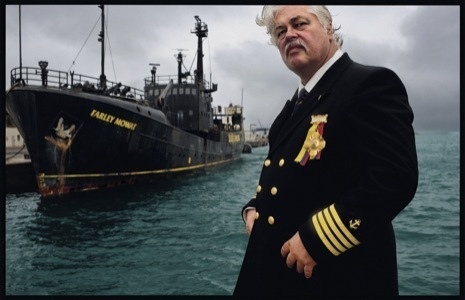
A recent essay in the New Yorker described the always intriguing exploits of Paul Watson’s ‘wild crusade to save the oceans’ Neptune’s Navy , New Yorker November 5, 2007. Hitting the headlines in Australia earlier this year, Watson’s crusade came to light via the hostage taking of two Sea Shepherd crewmembers after they boarded a Japanese whaling vessel illegally engaged in ‘scientific whaling research’ in the Southern Ocean.

I would say that these heroic deeds of Watson and his crew were rather universally admired in at least the Australian press. While there were some grumblings from the Australian government bureaucracy over the questionably legal tactics of the Watson’s big black ship, it was the Japanese whalers who fared worst. They were (also) breaking the law, after all. And no civilised person could ever condone whaling…

Raffi Khatchadourian’s New Yorker post has some interesting insights into the living Watson legend and the Sea Shepherd campaign. Insights like the fact that the Sea Shepherd has strengthened bows to faclitate its efforts to forcibly and intentionally ram whaling (and other) fishing vessels. Another is Watson’s rather tyrannical reign over his pirate flagged crew. And the sometimes scary lack of maintenance and, sometimes, unseaworthiness of his ship. But even more interesting were suggestions of a basic level of misanthropy as the foundation world view of the dashing man of action; and his eviction from Greenpeace on the foundation of his rather unremitting dedication to physical violence as opposed to their preferred passive resistance model. The article also delves down to a discussion on the anthropocentric-ecocentric distinction and the philosophical roots of deep ecology. Watson is a man who seems refreshingly keen to say exactly what he thinks; like there being a good few billion too many humans on the planet; that the hegemony of humans is over asserted in all our environmental policy making affairs, and…if you don’t like what he’s got to say, well, you can always jump ship! It’s a wonderful essay.

What intrigues me on all this is the momentum Watson provides to force us all to contemplate a spectrum for human-ecology relationship: a spectrum from the abysmal extremes of pure anthropocentricism asserted by its white knights of the economics profession, through to, right at the other extreme of ecocentricism, people just like him. Clearly, people do sit across a sepectrum. Even if one were to denounce Watson (as no doubt many in the Japanese whaling business would do), we are forced to realise that people with views such as his exist. And, their viewpoints are asserted in most colourful ways. Which means that if governments won’t privilege positions such as theirs with suitable empowerment, Watson and Co. seem to be rather more than capable of privileging their position all on their own! Their position is hardly subtle. The pirate flag and military decor of Captain Watson are not even thinly disguised messages to this effect.

To draw some ideas from one of my favourite turfs, Watson asserts the breadth of the discursive society. He asserts the reality of divergence of viewpoint, mental models and philosophical position. So much of our contemporary environmental policy making seems to be devoted to the fantasy of commuinity ‘hermeneutical’ homogenity: that we all have, more or less, the same outlook. Policy bureaucrats seem intent on forcing their one-size-fits-all cookie cutter economics machinery into the formulation of policy frameworks that fit the world only in theory. Too much of messy, discursive reality is assumed away as ‘aberration’ and the musings of the nutters. The ‘white noise’ of economics is a rather fertile ground. It is that place that contains, generally, the far more realistic bits of human behaviour that economic theory cannot sensibly represent. Things like the reality of a spectrum of ecophilosophical positions, rather than the (implicit, but theoretically asserted) assumption that we are all defined as a uniformity of profit maximising, utility optimising invisible hand driven community of short sighted carpet bagging rent maximisers…

While you or I might not actually want to go sign up for passage on the Sea Shepherd, we are forced to notice that manifestation of world views that, perhaps, are vastly different to our own (especially, as I said, if you are a Japanese whaler). This means that we can’t really just ignore world views such as Captain Watson’s in our efforts to devise one-size-fits-all environmental policy prescriptions because, to be blunt, the Sea Shepherd my well point its metaphorical gun our way and blow us out of the water. Now that forces the necessity to give the complexities of real world policy making some more detailed attention.

All of which means, in my view, that our ecocentrically inclined co-inhabitants of the human social melle provide a critically important service. They preclude the inanity of compressed opinion and flock-like conformity to theoretically defined models of economic-ecological interaction. The danger from that kind of conformity is pretty stark: if the theories are wrong or faulty, a blissfully bleating well ordered flock will quickly become extinct. One only needs to note the current human-induced acceleration of global warming to derive at least a few indicators of that our policy making models are in need of major overhaul. The big guns of the Sea Shepherd inspire us to react a little more quickly and with more creativity than might be the case if Watson et al were to simply take up furious letter writing campaigns instead. There is nothing like a ship ready willing and able to ram our policy barge if it heads too far off course. But, I am keen to state, I am not advocating the transfer of our democratic helm to the Captain Watson’s of the world. Their task is to remain on the side, as a peripheral spectre of a less ‘forgiving state’ should our engagement of the robustly divergent discursive community relapse back to fantasies of a tame artificial world of people and place ordered by the dictates of theories rendered reckless through their naivety. There is nothing simple about the way our socio-economic systems work. Captain Watson keeps us awake and vigilant when, otherwise, the torpor of academic wish models might otherwise blanket us all.